Imagine you’re on a US-based DeFi dashboard about to move $10,000 worth of tokens into a new liquidity pool. The dApp asks you to sign a transaction with a long, inscrutable calldata payload. Your wallet pops up a simple «Confirm» button. Do you hit it? For many seasoned DeFi users the familiar answer is: not until you know exactly what will change in your balances, which contract will have which approvals, and how much gas you’ll burn. Rabby Wallet is built around that friction point — preventing the classic «blind signing» failure mode — and that design choice reshapes several trade-offs you should understand before you download and install it.
This article explains the mechanism Rabby uses to simulate and surface transaction outcomes, how that approach alters the security model compared with competitors, where it still leaves gaps, and practical decision heuristics for choosing Rabby vs. alternatives for multi-chain DeFi workstreams in the US market.
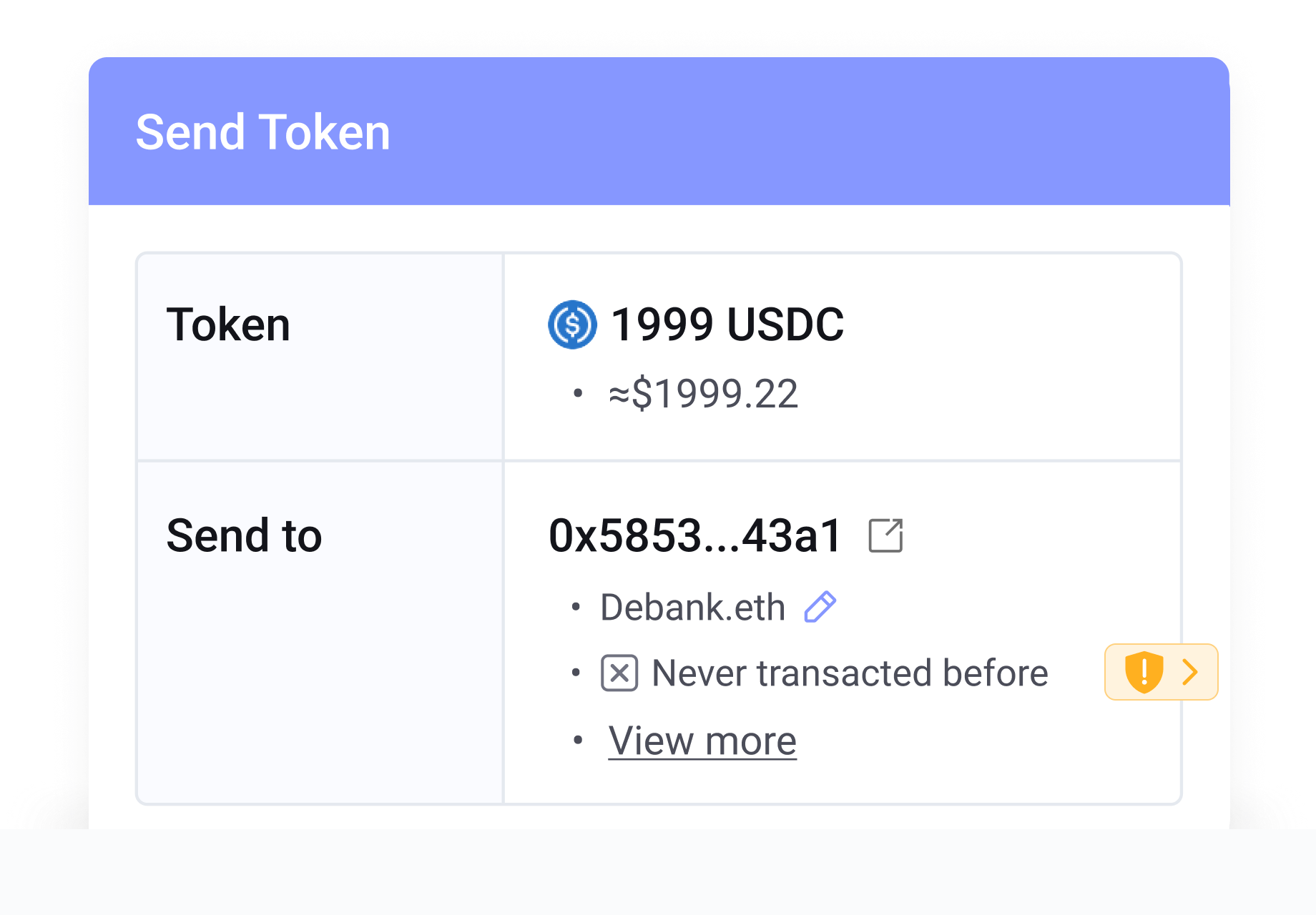
How Rabby’s transaction simulation works — mechanisms, not slogans
At its core Rabby prevents blind signing by running a local or proxied simulation of the transaction before it asks the user to sign. Mechanically this means parsing the intended transaction (to-contract address, calldata, token amounts, gas settings) and executing a dry run against a node or a simulation engine that replays what will happen if the transaction were mined now. The simulation yields precise, user-facing outputs: estimated token balance deltas, the fee cost denominated in the chain’s gas token, and any state changes such as approvals or contract interactions.
That output is then translated into an intelligible interface: explicit «You will lose/receive X tokens» lines, flags for suspicious recipients, and warnings for approvals that open potentially unlimited token spend permissions. The wallet also applies a pre-transaction risk scan looking for signals like previously hacked contracts or addresses with no on-chain history. This pipeline — parse, simulate, flag, present — is the practical mechanism that turns an opaque calldata blob into a decision-useful summary for a human signer.
Why this mechanism matters for DeFi power users
For active DeFi traders, yield farmers, and protocol auditors the difference between «simulates then signs» and «sign then later discover» is material. Simulation shrinks the attack surface in two ways: it reduces accidental transfers to phishers or wrong chains, and it discourages automatic approvals that expose token allowances indefinitely. When paired with an approval-revocation tool, the simulation is part of a workflow that prevents small mistakes from becoming irreversible losses.
Rabby’s multi-chain support (90+ EVM chains) and automatic network switching further reduce human error: when you click a dApp on Arbitrum, Rabby will switch you to the right network instead of leaving you to realize you were operating on Ethereum mainnet. For US users operating across Layer 2s and alternative EVM chains, that behavior cuts the common mistake of sending funds on the wrong chain or paying the wrong gas token.
Trade-offs and limitations — what simulation does not solve
Simulation is powerful but not omnipotent. It depends on the accuracy of the node state at the time of simulation; front-running, mempool reorgs, and miner-extracted value (MEV) attacks can change outcomes between simulation and inclusion. Simulations typically assume deterministic execution given current state; they cannot foresee an adversary that reacts within the mempool window. Put simply: simulation reduces accidental blind-sign occurrences but cannot eliminate dynamic, adversarial behaviors that occur after signing.
Rabby’s known limitations are also material for US-based DeFi users: there is currently no built-in fiat on-ramp, meaning users must acquire crypto off-wallet via centralized exchanges or third-party services before interacting. Rabby also lacks native in-wallet staking tools, so users who want a single app for fiat-to-stake flows will need extra steps. Finally, Rabby has a past security incident (a 2022 exploit of Rabby Swap) that the team addressed through freezing the contract and compensations — a reminder that a wallet’s feature set matters less when a protocol it interacts with is compromised.
Security posture and integrations: practical implications
Rabby’s security model is layered: transaction simulation and pre-transaction risk scanning at the client level, hardware wallet support for key signing, and integration with institutional custody/multi-sig solutions like Gnosis Safe. For large US entities or users managing material balances, the practical workflow becomes: use Rabby’s extension or desktop app for simulation, pair the signing device to a hardware wallet or Gnosis Safe for consensus, and employ the revocation tool after high-risk approvals. That combination preserves the benefits of Rabby’s UX while keeping private keys off online endpoints.
There are trade-offs in usability: hardware wallets slow down interaction and add friction for frequent traders. But for treasury-level operations or large LP position adjustments, the friction is beneficial — it inserts deliberate time for human review and allows Rabby’s simulation results to be cross-checked against an auditor’s expectations.
Comparison with alternatives — where Rabby stands out and where it concedes ground
MetaMask, Trust Wallet, and Coinbase Wallet cover many typical user needs but differ in emphasis. Rabby’s main differentiators are the on-the-fly simulation, the pre-transaction risk engine, the approval revocation UX, and automatic network switching. These features are particularly useful for advanced DeFi strategies: complex contract interactions, cross-chain bridging sequences, and batch approvals. The trade-off is that Rabby does not offer in-wallet fiat purchases or native staking — areas where Coinbase Wallet and some custodial solutions provide a smoother route from fiat to DeFi positions.
Another practical distinction: Rabby’s open-source codebase and MIT license invite audits, which supports institutional adoption and third-party analysis. But open-source status is not the same as formal guarantees; regular security audits and responsible disclosure processes are complementary necessities. For US institutions, Rabby’s integrations with enterprise vendors (Fireblocks, Amber) make it easier to slot into an institutional custody stack, provided those vendors’ compliance and custody practices meet the organization’s regulatory and risk requirements.
How to decide: a few decision-useful heuristics
If you regularly interact with unfamiliar dApps, handle approvals, or maintain positions across multiple L2s, Rabby’s simulation and revocation tools provide asymmetric safety gains. Use Rabby when: you need granular, pre-sign visibility into token deltas; you manage many approvals; or you swap between many EVM chains and want automatic network switching to reduce human error.
Consider alternatives when: you prioritize an integrated fiat on-ramp and simplified custody for small amounts; you are locked into a custodial exchange ecosystem that already satisfies compliance and liquidity needs; or you need a mobile-only wallet without desktop usage. In practice many power users will mix tools: acquire assets on a US-compliant exchange, move them to a hardware-backed Rabby account for DeFi operations, and use the approval-revoke cycle as a standard part of position management.
Installation, download, and platform availability
Rabby is distributed as a Chromium browser extension (Chrome, Brave, Edge), a mobile app (iOS and Android), and a desktop client (Windows and macOS). The extension offers a ‘Flip’ toggle to switch default wallet behavior with MetaMask, and it supports importing existing seed phrases or private keys — so migration is straightforward for users switching wallets. If you want to learn where to download the official client or get setup guidance, see this resource on the rabby wallet page which aggregates installation options and setup notes.
Important installation hygiene: always confirm signatures and checksums from official channels, prefer installing browser extensions from official stores, and avoid copying seed phrases into web forms. For US users, be mindful of privacy and tax implications when moving assets from custodial exchanges into self-custody; the wallet doesn’t obviate reporting obligations.
What to watch next — conditional scenarios and signals
Three conditional developments would change Rabby’s relative attractiveness. First, a secure, integrated fiat on-ramp would reduce the onboarding friction for retail users and could broaden Rabby’s user base; this depends on partnerships with regulated payment providers or relays. Second, adoption of stronger simulation methods that model mempool adversaries or integrate MEV-aware estimations would materially improve the guarantee from «what would happen now» to «what is likely to happen before inclusion» — yet these are research-intensive additions. Third, any major new security incident affecting Rabby or an adjacent service would reset user trust; conversely, successful, transparent audits and bug-bounty outcomes would strengthen institutional confidence.
Monitor these signals: announcements of regulated fiat partners, published audits that include mempool-aware simulation capabilities, and data on real-world loss events tied to the wallet ecosystem. Those are clearer leading indicators than marketing claims.
FAQ
Does Rabby prevent all smart-contract exploits?
No. Rabby reduces accidental blind-signing and flags many known risks, but simulations cannot fully defend against adversarial actors who act in the mempool or exploits in third-party contracts. Use hardware wallets and multi-sig for higher assurance, and treat Rabby’s simulation as a strong but not absolute safety layer.
Can I use Rabby with a Ledger or Trezor device?
Yes. Rabby supports a wide range of hardware wallets (Ledger, Trezor, Keystone, CoolWallet, GridPlus, BitBox02). Pairing a hardware signer with Rabby preserves the simulation UX while keeping your keys offline for signing.
How do I revoke token approvals from Rabby?
Rabby includes a native approval revocation tool. It lists active allowances you have granted and lets you cancel or reduce them. Make revocation part of your regular hygiene after authorizing new contracts or DEX interactions.
Does Rabby support non-EVM chains?
Rabby focuses on EVM-compatible chains and supports over 90 of them, including Ethereum, BNB Chain, Arbitrum, Optimism, Polygon, and Avalanche. For non-EVM ecosystems you will need other wallets specialized for those chains.